


Recognising Common Garden Birds and Their Songs
Learn to identify robins, blue tits, and blackbirds by sight and sound. A quiet spot near a window or feeder makes watching easier.

Start Where You Already Are
Spring arrives in a British garden long before it arrives in the calendar. By late February the light has shifted, the soil smells different, and the birds that spent winter in loose, quiet flocks begin to pair up and sing properly. Learning to recognise half a dozen species by sight and sound turns a few minutes at the window into something closer to a daily conversation.
You do not need a hide, expensive binoculars or much time. A stool by a window, a feeder within four or five metres, and a shrub or hedge nearby for cover will do far more for your birdwatching than any piece of kit. Sit still, keep the glass clean, and let the birds come to you.
The Robin: Sweet, Silvery and Fiercely Territorial
The robin is usually the first song most of us learn without realising it. Both males and females sing, and they sing almost all year — one of the few garden birds whose voice you can hear in December as well as May. The song is a thin, silvery warble: high, wistful phrases that seem to trail off before starting again, with a faint quiver at the end.
Sight identification is straightforward. Look for a rounded, plump bird with a warm orange-red breast, brown back and dark eye. Robins often sing from a low, exposed perch — a spade handle, a fence post, the top of a hedge — rather than from the canopy, so listen at roughly head height.
- Song: high, sweet, silvery phrases with clear pauses between them
- Call: a sharp, ticking "tic-tic-tic", often used as a scolding alarm
- Look for: orange-red breast, upright stance, a habit of following digging
In towns, robins often sing at night under street lighting, which is why a late-evening walk in March can suddenly sound like midsummer.
Blue Tits: Small, Busy and Constantly Commenting
Blue tits are the acrobats of the feeder, hanging upside down from fat balls and probing seed heads with endless energy. Their song is thin and remarkably high — a repeated "tsee-tsee-tsee" that can run into a tumbling trill. Some older ears struggle to hear it at all, which is nothing to worry about; watch for the open beak and the quivering body instead.
Identification is easy once you have seen one properly: a blue cap and blue wings, yellow-green back, yellow belly, and a white face with a dark line running through the eye. They nest readily in boxes with a 25 mm entrance hole, and they queue politely at sunflower hearts and peanuts.
- Song: high, thin "tsee-tsee-tsee", often ending in a rapid trill
- Call: a fussy, clipped version of the same notes as they move through in twos and threes
- Look for: blue cap, white cheeks, upside-down feeding posture
Blackbirds: The Flute in the Dawn Chorus
If the robin is the wistful voice of the garden, the blackbird is the confident one. Its song is rich, mellow and flute-like, delivered in unhurried phrases with obvious gaps between them. Males sing from a high perch — a chimney pot, a television aerial, the top of a tree — most intently in the first hour after sunrise and again at dusk.
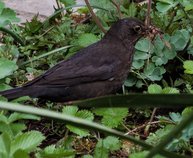
Males are black with a bright orange-yellow bill and eye-ring; females are brown with a paler, speckled breast and a duller bill. The alarm call is unmistakable: a clattering "chook-chook-chook" followed by a thin, high "seee", usually aimed at a cat. Learn that sound and you will know when something is moving through your borders.
Blackbirds feed on the ground, so they prefer a dish of mealworms or a scatter of fruit and sunflower hearts under a bush rather than a hanging feeder.
Telling Similar Songs Apart
The trick with unfamiliar songs is to give each one a hook you can remember. The great tit's spring song is a ringing, two-note "teacher-teacher", repeated insistently and sounding, frankly, a little cross. The chaffinch finishes with a flourish — a cascade of notes that drops and ends in a brisk "chip". The dunnock keeps things quiet and hurried, a brief, thin warble easily missed under the blackbird.
Once you know four or five, you can start listening for who is singing rather than just that someone is. Keep a small notebook by the window and jot down the date, the weather and the first song you hear. Within a few weeks you will notice the dawn chorus building towards its peak in early May, usually best enjoyed in the half hour after sunrise, when the air is still and sound carries.
Spring Jobs That Make Listening Easier
- Clean feeders weekly with warm, soapy water and rinse thoroughly — a hygiene routine keeps birds healthy and coming back.
- Provide shallow water in a dish with a few stones for grip, refreshed daily; birds drink and bathe more than most people expect.
- Hang a nest box facing between north and east, two to three metres up, away from a cat's launch point.
- Leave a wild corner of long grass, nettles and seed heads over spring to supply insects and natural cover.
- Reduce window reflections with a feeder placed close to the glass, so birds cannot build up speed before impact.
None of this has to be done at once. Put out a feeder, sit down for ten minutes with a cup of tea, and let the garden tell you what is already there.
Post a comment